Judging Character: Why Hiring Teams Are Taking Assessment Days to the Waterfront
Photo: Cecil Stoughton. White House Photographs. John F. Kennedy Presidential Library and Museum, Boston, Public domain, via Wikimedia Commons
Ask a hiring manager what they remember about an assessment day and they will rarely describe the competency framework. They will describe the building. Twelve candidates in a windowless hotel suite off a motorway junction produce a certain kind of afternoon; the same twelve in a room above a harbour produce a different one. That difference is not decoration. It changes how people behave, and therefore what you are able to observe.
This is an argument, not a neutral survey. Waterfront venues are not automatically the right choice for every recruitment process, and this article will say where they are not. But for senior appointments, small-cohort assessment centres and final-stage interview days, the case is stronger than most HR teams assume.
The arrival is part of the assessment
Assessment days are designed to take candidates out of familiar surroundings and observe them under mild pressure. The journey in matters more than it should. A railway station ten minutes' walk from the door, a straightforward route, and a reception where someone is expected are worth more than a glossy atrium with confusing signage.
Waterside venues introduce a particular dynamic: the walk along a quay or through a marina is pleasant but disorienting, and briefing candidates to arrive at a specific entrance rather than a general postcode is essential. Ask the venue to send a short arrival note, with a map, a photograph of the door and a named contact. Nervous candidates who arrive flustered at the wrong building will spend the first forty minutes of the day recovering rather than performing.
There is also a level question. For early-careers volume recruitment, a waterfront setting can read as incongruous — impressive but unnecessary. For senior and specialist roles, where the day is as much about candidate courtship as assessment, the setting earns its keep.
Privacy before panorama
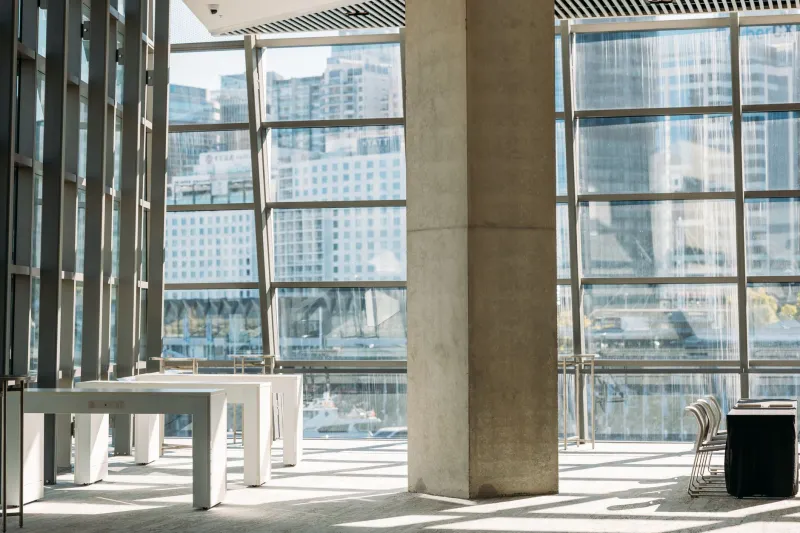
Glass walls and open water make for beautiful photographs and poor confidentiality. Before anything else, establish who can see into each room. A public promenade outside a ground-floor interview room is a genuine problem whether or not a soundproof partition is doing its job. Ask specifically about frosting, blinds, mezzanine sightlines and whether the room sits on a public route through the building.
Sound deserves equal attention, in both directions. A panel deliberating in a room next to a waiting area is a confidentiality risk; a candidate rehearsing a presentation in a corridor is an awkward one. Walk the circulation routes and confirm that waiting, assessment and deliberation can each be kept separate.
Finally, the small items that trip teams up: candidate names on printed signage, sign-in sheets left on a reception desk, whiteboards carrying scoring notes in a room that is later used for a break. Brief the venue on all three.
Room stacking for parallel panels
Most assessment days fail on logistics rather than judgement. If you are running three panels in rotation, you need three rooms that allow a private conversation at normal volume, a fourth space for candidates to wait without hearing anything through the wall, and a fifth for the panel to confer. That is a heavier requirement than a single boardroom, and it is where venues with long, adaptable floor plates — converted warehouses, harbour-side studios, former sail lofts — tend to outperform traditional conference suites.
Ask the venue to supply a floor plan and to mark your routes on it. Staggered timings only work if the corridor is not shared. It is also worth keeping one quiet room in reserve: a candidate who becomes unwell, receives difficult news or simply needs fifteen minutes will need it, and finding one at short notice is rarely easy.
Catering, timing and the 4pm wind
The working day should be designed so that the water is a punctuation mark rather than a distraction. Breaks on a terrace are excellent; presentations next to an open terrace door are not. Schedule refreshments away from assessment rooms and, if the venue sits beside a working harbour, avoid the window in which boats are moving in and out on the tide.
Catering logistics need early attention. Quayside venues frequently have restricted vehicle access, which affects delivery times and the temperature at which food arrives. Confirm the drop-off point, ask who receives deliveries, and be explicit about dietary requirements being labelled rather than guessed at. For afternoon sessions, keep lunch light and the coffee plentiful; a heavy lunch beside a view is a sleeping draught.
Briefing the venue on confidentiality
Put the expectations in writing before the day, not on the morning. A short brief should cover: the purpose of the event, the level of the roles, the fact that candidates are not publicly associated with the organisation, and a clear instruction that no photography or social media content is to be produced. Name a single venue contact and a single client-side contact, and ask that any room servicing happens outside scheduled interview times.
Where assessment materials are involved, ask whether documents can be locked away overnight and how materials are disposed of after the event. If the process involves recording, confirm camera and microphone availability in advance and make sure candidates are told clearly and consistently.
When a city-centre room is the better answer
If you are assessing forty candidates in a single day, a waterfront venue is likely to be the wrong instrument — the travel times between rooms, the restricted access and the premium on space all work against volume. The same applies where the day depends on specialist equipment, tight rail connections or several back-to-back cohorts. Waterside works best for a considered process with a small cohort and a genuine decision at the end of it.
A pre-booking brief for hiring teams
- Confirm visual privacy for every interview and deliberation room
- Secure a separate waiting area with no audible overspill
- Map circulation so candidates and panels do not cross unnecessarily
- Agree signage and disposal of candidate names and scoring notes
- Confirm delivery access and the receiving contact for catering
- Check tide and harbour traffic against the session timetable
- Name a venue contact and set the photography and social media position in writing
- Hold one room in reserve for the unexpected
Chosen well and briefed properly, a room by the water does something a hotel suite cannot: it signals that the organisation has thought about the day from the candidate's side of the table. For a final-stage hire, that signal is worth more than the difference in room rate.